

- Onions & Shallots - Instructions for Growing from Sets | Tech Sheet (PDF)
- Onion & Leek Production from Transplants | Tech Sheet (PDF)
- Pelleted Onions | Key Growing Information
- Onions | Key Growing Information
- 4 Great Reasons to Grow 'Blush' Onion
- Overwintering Onions for Spring Harvest | Johnny's Selected Seeds
- Cipollini, Mini & Specialty Onions | Key Growing Information
- Map of Long-Day, Intermediate-Day & Short-Day Onions
- Full-Size Onion Varieties | Comparison Chart (PDF)
- Bunching Onions | Key Growing Information
- How to Grow Scallions • From Seed to Harvest
- Winter Growing Guide | Part 6: Recommended Crops & Varieties
- Classic Storage Crops | Post-Harvest Handling & Storage Guidelines
- Onion Sets | Key Growing Information
Onion Sets - Key Growing Information
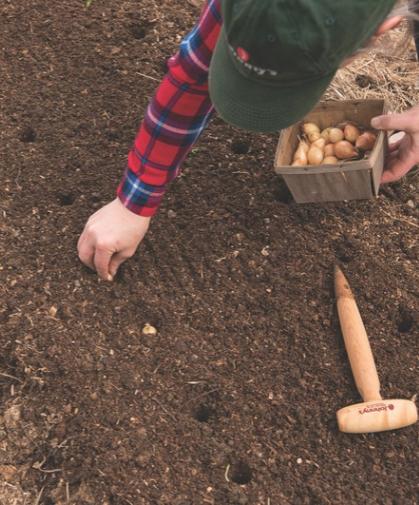
Culture: Onion and shallot sets should be planted as soon as possible—ideally within one week of receiving them. If you cannot plant immediately, store in a cool, dry, and dark place with good ventilation. Allium crops require fertile, well-drained soil with a pH of 6.0–7.0. Sandy loam soils are ideal, so raised beds or raised rows are recommended for heavier soils to promote soil drainage. Full sun is required for optimal growth. Alliums require frequent irrigation during the growing season and the equivalent of 1" of water per week.
Planting: Plant with the base of the bulb (the rounded root-end portion of the bulb) facing down. Onion sets: plant approximately 1" deep, 4–6" apart in rows 12–18" apart. Shallot sets: Plant about 1" deep (or 3/4 their length), so that the pointed tips are visible above the soil level. For larger, single shallot bulbs, separate bulblets if attached in a cluster and space individually 3–4" apart, in rows 8–12" apart. Or, for a smaller, more traditional size and shape shallot, plant in clusters of 3–4 bulbs per hole or plant singly at 1–1 1/2" spacing. If you would like to harvest some of the crop during the growing season green or fresh, space plants closer in-row and harvest every other onion as needed. For spring planting, plant sets as soon as the soil can be worked. For fall plantings, plant around the same time you would garlic, before the ground freezes (we plant mid-October through late November in hardiness Zone 5a). Irrigate as necessary until the ground freezes. We recommend growing in a low tunnel: cover with row cover once temperatures are consistently dropping below 25°F (-4°C) and add a layer of greenhouse plastic before winter low temperatures set in. Vent the tunnel in spring to avoid excessive heat and remove the covering entirely once the threat of snow has passed and high temperatures are consistently above 25°F (-4°C).
Diseases, Insects & Weeds: Adequate air circulation will aid in reducing the risk of foliar disease, as does crop rotation and good sanitation—remove all culls and crop debris each season. Thrips are the most common Allium crop pest. Reduce thrips' overwintering habitat by keeping fields free of weeds and crop debris. Combat serious thrips infestations withinsecticides such as spinosad, pyrethrin, or insecticidal soap (see our Insect Control Chart). Overhead irrigation can also help knock thrips down off leaves (however, overhead irrigation can also increase the risk of foliar disease). Controlling weeds is also critical to the success of your onion or shallot crop. Competition from weeds will reduce yields and encourage insect pest populations. Cultivate carefully so as not to damage the base of the plants and shallow root systems. An application of organic mulch will also help control weeds and preserve moisture. All Johnny's onion and shallot sets are tested and certified free from the presence of white rot and parasitic nematodes.
Harvest & Curing: For bunching green onions, harvest once small bulbs have developed. For full-size onion/shallot bulbs, discontinue watering when the necks become soft and tops begin to fall over. When approximately 50% of the tops have fallen over on their own, pull the bulbs out of the ground and let dry in the sun for 2–7 days depending on the weather. Lay the tops of one row over the bulbs of another to prevent sunscald. Avoid curing outdoors if rain is forecasted or in full sunshine on especially hot days. If the weather is not conducive to outdoor curing, bulbs can be cured in a barn or shaded greenhouse. When foliage and necks are completely dry, clip roots and cut back tops to 1" or braid uncut tops together to group for storage. Note: if you are satisfied with the bulb size, you can manually bend the tops over early to halt the maturation process and begin the drying process.
Storage: Store cured bulbs in mesh bags or vented boxes at near freezing temperatures with 65–70% relative humidity. If properly cured, onions bulbs will store for approximately a minimum of 3 months and shallot sets for up to 8 months. Every few weeks, stored bulbs should be sorted to eliminate any which may have begun to decay.